Saturday, April 24, 2010

Happy Birthday, Hubble

"Here's looking at you, kid."


Eye Of Heaven (MyCn18)


Happy birthday to the Hubble Telescope

The Hubble Telescope was launched on April 24, 1990. NASA says the best is yet to come.
The Hubble Space Telescope launched on April 24, 1990 with a flawed mirror, but survived for two decades in large part because of five repair missions by space shuttle astronauts. Its cosmic gaze has led to breakthrough discoveries about the universe and embedded stunning views of the cosmos in the hearts and minds of the public.

"Hubble has done all those things and become an icon of science because it can produce glorious images," said Rick Fienberg, an astronomer and press officer of the American Astronomical Society.

But there's bigger and better science yet to come.


Cat's Eye Nebula (NGC 6543)


Labels:

Thursday, March 18, 2010

Cosmic Rosebud

“The universe is full of magical things
patiently waiting for our wits to grow sharper.”

~Eden Phillpotts, A Shadow Passes


WISE telescope captures space 'rose'


NASA's new infrared telescope has produced another stunning image of newly born stars emerging from dusty clouds.

NASA released the image of the "cosmic rosebud" Wednesday, showing stars in the Berkeley 59 cluster, about 3,300 light years from Earth.

The false colours in the image are meant to represent different wavelengths of infrared light captured by the Wide-field Infrared Survey Explorer, or WISE, satellite.

The blue dots to the right of centre of the image represent stars that are just a few million years old, very young on the scale of lifetimes of stars. The red glow surrounding the stars is dust in the nebula heated by the stars.

The green material is essentially ash, chemicals called polycyclic aromatic hydrocarbons that are the result of combustion. The material is found on Earth in such places as fireplaces, barbecue pits and exhaust pipes.

The blue stars around the edges of the image are stars from our own Milky Way galaxy.

The gas and dust in this nebula have been blown outward by a supernova, giving it a flower-like shape.

Astronomy Picture of the Day

Labels:

Sunday, November 09, 2008

Happy Birthday, Carl Sagan

Carl Edward Sagan

November 9, 1934 – December 20, 1996


"The world is so exquisite, with so much love and moral depth, that there is no reason to deceive ourselves with pretty stories for which there's little good evidence. Far better, it seems to me, in our vulnerability, is to look Death in the eye and to be grateful every day for the brief but magnificent opportunity that life provides."

~ Billions and Billions, "Thoughts on Life"


The Pale Blue Dot

5:12

Labels: ,

Monday, April 14, 2008

Quoting Carl

Personally, I would be delighted if there were a life after death, especially if it permitted me to continue to learn about this world and others, if it gave me a chance to discover how history turns out.
_____

For most of human history we have searched for our place in the cosmos. Who are we? What are we? We find that we inhabit an insignificant planet of a hum-drum star lost in a galaxy tucked away in some forgotten corner of a universe in which there are far more galaxies than people. This perspective is a courageous continuation of our penchant for constructing and testing mental models of the skies; the Sun as a red-hot stone, the stars as a celestial flame, the Galaxy as the backbone of night.
_____

Human history can be viewed as a slowly dawning awareness that we are members of a larger group. Initially our loyalties were to ourselves and our immediate family, next, to bands of wandering hunter-gatherers, then to tribes, small settlements, city-states, nations. We have broadened the circle of those we love. We have now organized what are modestly described as super-powers, which include groups of people from divergent ethnic and cultural backgrounds working in some sense together — surely a humanizing and character building experience. If we are to survive, our loyalties must be broadened further, to include the whole human community, the entire planet Earth. Many of those who run the nations will find this idea unpleasant. They will fear the loss of power. We will hear much about treason and disloyalty. Rich nation-states will have to share their wealth with poor ones. But the choice, as H. G. Wells once said in a different context, is clearly the universe or nothing.
_____

I worry that … pseudo-science and superstition will seem year by year more tempting, the siren song of unreason more sonorous and attractive. Where have we heard it before? Whenever our ethnic or national prejudices are aroused, in times of scarcity, during challenges to national self-esteem or nerve, when we agonize about our diminished cosmic place and purpose, or when fanaticism is bubbling up around us — then, habits of thought familiar from ages past reach for the controls. The candle flame gutters. Its little pool of light trembles. Darkness gathers. The demons begin to stir.
_____

We have also arranged things so that almost no one understands science and technology. This is a prescription for disaster. We might get away with it for a while, but sooner or later this combustible mixture of ignorance and power is going to blow up in our faces.
_____

Widespread intellectual and moral docility may be convenient for leaders in the short term, but it is suicidal for nations in the long term. One of the criteria for national leadership should therefore be a talent for understanding, encouraging, and making constructive use of vigorous criticism.
_____

If we can't think for ourselves, if we're unwilling to question authority, then we're just putty in the hands of those in power. But if the citizens are educated and form their own opinions, then those in power work for us. In every country, we should be teaching our children the scientific method and the reasons for a Bill of Rights. With it comes a certain decency, humility and community spirit. In the demon-haunted world that we inhabit by virtue of being human, this may be all that stands between us and the enveloping darkness.
_____

It's better to light a candle than to curse the darkness.
_____

The choice is with us still, but the civilization now in jeopardy is all humanity. As the ancient myth makers knew, we are children equally of the earth and the sky. In our tenure of this planet we've accumulated dangerous evolutionary baggage — propensities for aggression and ritual, submission to leaders, hostility to outsiders — all of which puts our survival in some doubt. But we've also acquired compassion for others, love for our children and desire to learn from history and experience, and a great soaring passionate intelligence — the clear tools for our continued survival and prosperity. Which aspects of our nature will prevail is uncertain, particularly when our visions and prospects are bound to one small part of the small planet Earth. But up there in the cosmos, an inescapable perspective awaits. National boundaries are not evident when we view the Earth from space. Fanatic ethnic or religious or national identifications are a little difficult to support when we see our planet as a fragile blue crescent fading to become an inconspicuous point of light against the bastion and citadel of the stars. There are not yet obvious signs of extraterrestrial intelligence, and this makes us wonder whether civilizations like ours rush inevitably headlong to self-destruction. I dream about it, and sometimes they're bad dreams.
_____

The Earth is the only world known so far to harbor life. There is nowhere else, at least in the near future, to which our species could migrate. Visit, yes. Settle, not yet. Like it or not, for the moment the Earth is where we make our stand.
_____

Our species needs, and deserves, a citizenry with minds wide awake and a basic understanding of how the world works.
_____

The nature of life on Earth and the search for life elsewhere are two sides of the same question: the search for who we are.
_____

We have heard the rationales offered by the nuclear superpowers. We know who speaks for the nations. But who speaks for the human species? Who speaks for Earth?
_____

If we long for our planet to be important, there is something we can do about it. We make our world significant by the courage of our questions and by the depth of our answers.
_____

Anything else you're interested in is not going to happen if you can't breathe the air and drink the water. Don't sit this one out. Do something.

~ Carl Sagan ~
(1934 - 1996)

Labels: ,

Wednesday, January 16, 2008

Forget evolution. This Pope doesn't even believe in Astronomy.

Pope Benedict XVI has cancelled plans to give a speech at La Sapienza University in Rome.

The pontiff cancelled plans amid protests of a speech he gave in 1993 in which he called the trial and conviction of Galileo in 1633 for heresy over his observation that the earth was not the center of the universe (contradicting the doctrine of the medieval church on the subject) "reasonable and just" and suggested that the church back in the early 1600's had more reason on its side than Galileo.

I guess I'll quit worrying so much about creationists who want to censor my biology book. Now I'll have to start worrying about real fanatics, led by the Holy Father himself, who want to burn my physics book.

What comes next? Defending the 'reasonableness' of the Inquisition? Come to think of it, with the willingness of the Bush administration to justify torture, maybe as a matter of fact that will come next.

Labels: , ,

Sunday, April 22, 2007

Celebrate the Earth Day

Carl Sagan: "The Pale Blue Dot"

"Our posturings, our imagined self-importance, the delusion that we have some privileged position in the Universe, are challenged by this point of pale light. Our planet is a lonely speck in the great enveloping cosmic dark. In our obscurity, in all this vastness, there is no hint that help will come from elsewhere to save us from ourselves."


"Look again at that dot. That's here. That's home. That's us. On it everyone you love, everyone you know, everyone you ever heard of, every human being who ever was, lived out their lives. The aggregate of our joy and suffering, thousands of confident religions, ideologies, and economic doctrines, every hunter and forager, every hero and coward, every creator and destroyer of civilization, every king and peasant, every young couple in love, every mother and father, hopeful child, inventor and explorer, every teacher of morals, every corrupt politician, every 'superstar', every 'supreme leader', every saint and sinner in the history of our species lived there — on a mote of dust suspended in a sunbeam. [...] There is perhaps no better demonstration of the folly of human conceits than this distant image of our tiny world. To me, it underscores our responsibility to deal more kindly with one another, and to preserve and cherish the pale blue dot, the only home we've ever known."

Labels: , , ,

Friday, June 30, 2006

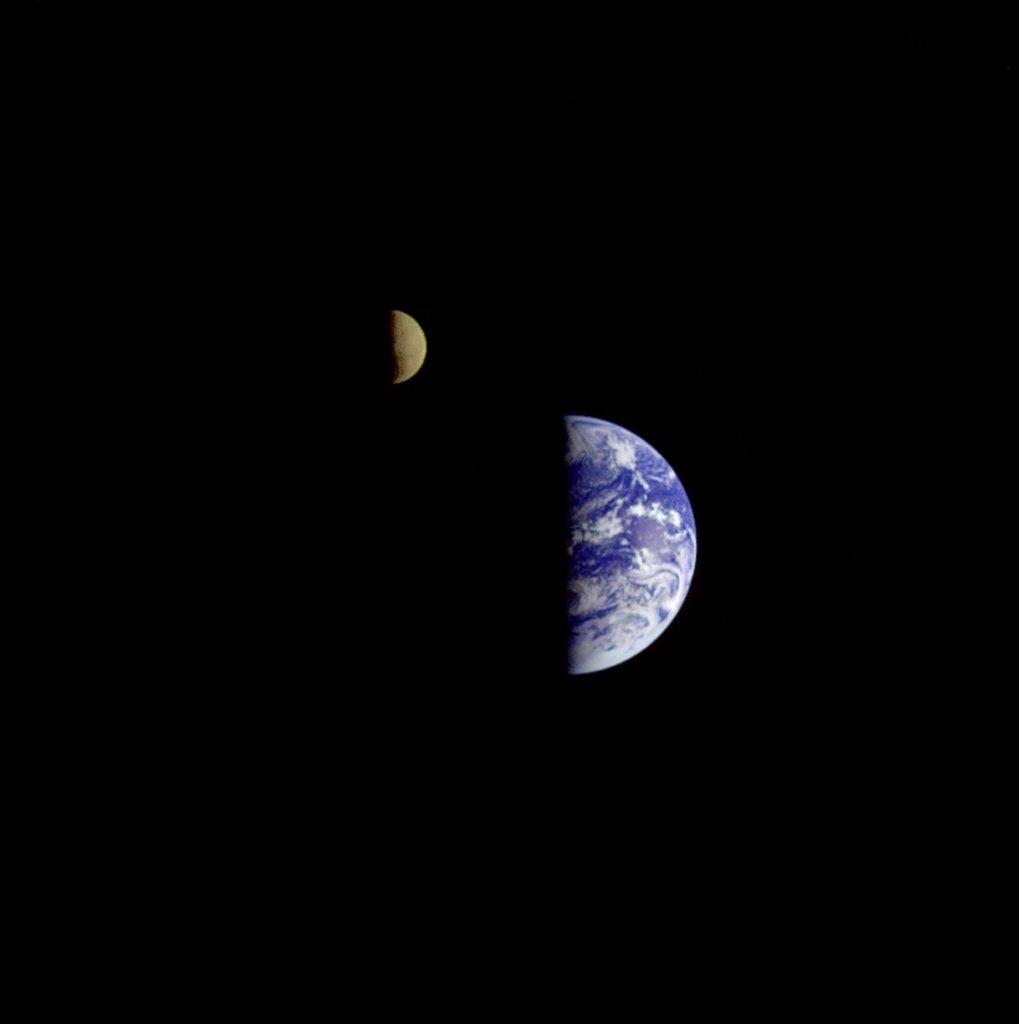
The Moon and The Pale Blue Dot

This image of the Earth and moon in a single frame, the first of its kind ever taken by a spacecraft, was recorded on Sept. 18, 1977, by Voyager 1 when it was 7.25 million miles from Earth. The moon is at the top of the picture and beyond the Earth as viewed by Voyager.

In the picture are eastern Asia, the western Pacific Ocean and part of the Arctic. Voyager 1 was directly above Mt. Everest (on the night side of the planet at 25 degrees north latitude) when the picture was taken.

The photo was made from three images taken through color filters, then processed at NASA's Jet Propulsion Laboratory. Because the Earth is many times brighter than the moon, the moon was artificially brightened so that both bodies would show clearly in the prints. Image Credit: NASA

Hat tip to:
Gregg for finding this photo, and the information on it.

Who are we?
We find that we live on an insignificant planet
of a humdrum star lost in a galaxy tucked away
in some forgotten corner of a universe in which
there are far more galaxies than people.
- Carl Sagan:

"Look again at that dot. That's here. That's home. That's us. On it everyone you love, everyone you know, everyone you ever heard of, every human being who ever was, lived out their lives. The aggregate of our joy and suffering, thousands of confident religions, ideologies, and economic doctrines, every hunter and forager, every hero and coward, every creator and destroyer of civilization, every king and peasant, every young couple in love, every mother and father, hopeful child, inventor and explorer, every teacher of morals, every corrupt politician, every 'superstar,' every 'supreme leader,' every saint and sinner in the history of our species lived there -- on a mote of dust suspended in a sunbeam."
- "You Are Here," Pale Blue Dot
-------------------
"The Cosmos may be densely populated with intelligent beings. But the Darwinian lesson is clear: There will be no humans elsewhere. Only here. Only on this small planet. We are a rare as well as an endangered species. Every one of us is, in the cosmic perspective, precious. If a human disagrees with you, let him live. In a hundred billion galaxies, you will not find another."
- "Who Speaks for Earth?" Cosmos
-------------------
"We are the product of 4.5 billion years of fortuitous, slow biological evolution. There is no reason to think that the evolutionary process has stopped. Man is a transitional animal. He is not the climax of creation."
- The Cosmic Connection
-------------------
"We must stop pretending we're something we are not. Somewhere between romantic, uncritical anthropomorphizing of the animals and an anxious, obdurate refusal to recognize our kinship with them - the latter made tellingly clear in the still-widespread notion of 'special' creation - there is a broad middle ground on which we humans can take our stand."
- Shadows of Forgotten Ancestors
-------------------
"The Earth is a very small stage in a vast cosmic arena. Think of the rivers of blood spilled by all those generals and emperors, so that, in glory and triumph, they could become the momentary masters of a fraction of a dot. Think of the endless cruelties visited by the inhabitants of one corner of this pixel on the scarcely distinguishable inhabitants of some other corner, how frequent their misunderstandings, how eager they are to kill one another, how fervent their hatreds.

"Our posturings, our imagined self-importance, the delusion that we have some privileged position in the Universe, are challenged by this point of pale light. Our planet is a lonely speck in the great enveloping cosmic dark. In our obscurity, in all this vastness, there is no hint that help will come from elsewhere to save us from ourselves."
- Pale Blue Dot
-------------------
"It has been said that astronomy is a humbling and character building experience. There is perhaps no better demonstration of the folly of human conceits than this distant image of our tiny world. To me, it underscores our responsibility to deal more kindly with one another, and to preserve and cherish the pale blue dot, the only home we've ever known."
- Pale Blue Dot
-------------------
"Our loyalties are to the species and the planet. We speak for Earth. Our obligation to survive is owed not just to ourselves but to that Cosmos, ancient and vast, from which we spring."
- Cosmos

Labels: ,


All rights reserved.
Disclaimer And Comment Policy