Tuesday, November 11, 2008

The Edmund Fitzgerald, Legend Of The Big Fitz

The fateful voyage of the Edmund Fitzgerald:

Fierce autumn storms on the Great Lakes have claimed their victims for centuries. Thousands of vessels have sunk and countless lives have been lost. Native Americans and the French voyageurs in turn mourned their dead. The first recorded tragedy was the sinking of the Le Griffin, belonging to the explorer LaSalle, with a load of furs in autumn of 1680.

Perhaps the most famous of the lakes' tragedies was immortalized by singer Gordon Lightfoot:

The legend lives on from the Chippewa on down
of the big lake they call Gitche Gumee
The lake it is said never gives up her dead
when the skies of November turn gloomy
With a load of iron ore 26,000 tons more
than the Edmund Fitzgerald weighed empty
that good ship and true was a bone to be chewed
when the gales of November came early

On Nov. 8, 1975, in the Oklahoma panhandle, the beginnings of a storm stirred the air. Picking up force, the storm moved through Iowa and Wisconsin. On Nov. 9, gale warnings were issued for Lake Superior.

By 2:15 p.m. on Nov. 9th, a giant lakes freighter had filled her cargo hold with 26,116 tons of taconite pellets in Superior, Wis., and was on her way south to Detroit, as an uneventful shipping season ran down. That vessel was the Edmund Fitzgerald. [...]

There were 29 men aboard on that November day, captained by Ernest McSorley, 63, of Toledo. [...]

The Fitzgerald came within 20 miles of the vessel Arthur Anderson, under the helm of Captain Jessie B. Cooper, near Two Harbors, Minnesota. The Anderson was also loaded with taconite pellets. The captains commiserated by radio over the storm's increasing intensity, and at 2:am Monday, the morning of the 10th, they decided to change course and take the northern route along Superior's north shore. This would put them in the lee of the Canadian shoreline, which hopefully would protect them from the gale force winds which were whipping up the seas.

At 7 a.m. Captain McSorley contacted his company to report that weather would delay his arrival at the Soo Locks. The Anderson was following the Fitzgerald at a distance of nearly 16 miles and keeping in contact.

Winds were high, and getting worse. Waves were eight to 10 feet in the early afternoon and increasing in power and size as the day wore on. [...]

As heavy snow began to fall, visibility became nil and the Edmund Fitzgerald disappeared from the Anderson's view. Waves reached 12 to 16 feet, whipped by winds gusting up to 90 miles per hour at the Soo Locks, which were shut down. The Coast Guard issued an emergency warning: all ships were to find safe harbor. By 6 p.m. the crashing waves were 25 feet high.

By Captain Cooper's reckoning, the Fitzgerald passed closer to the Caribou Island Six Fathom Shoal than he would have taken his own vessel.

McSorley's radar went out so he slowed his ship to allow the Anderson to catch up and guide him. He was unable to pick up the Whitefish Point radio beacon or see its light. The Fitzgerald also had two vents damaged, he reported, and was listing.

At 7:10 p.m. the Anderson radioed the Fitzgerald to warn of another vessel nine miles ahead, but they assured McSorley that on present course the ship would pass by to the west. The first mate of the Arthur Anderson signed off by asking, "How are you making out with your problem?" The Fitzgerald replied: "We are holding our own."

It was the last contact with the ship.

The snow was letting up and the Anderson crew began sighting other ships. None were the Fitzgerald. The 729-foot mammoth was missing.


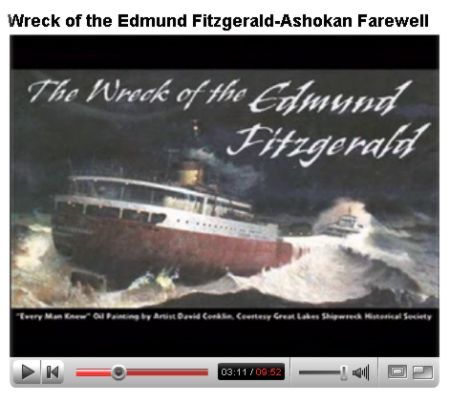
6:34


Videos are available for purchase at Edmund Fitzgerald.com:

You've heard the story of the ill-fated Edmund Fitzgerald, the 729-foot freighter that sank in a violent Lake Superior storm in November 1975. There has been no greater loss in Great Lakes history and very few disasters anywhere have captured the imaginations of marine enthusiasts in such a compelling fashion. Southport Video takes you to the site of the famous vessel's resting place. Compelling underwater footage of the wreck as it is today, and rare footage of her launch and sailing, combined with numerous rare photographs, beautiful artwork, computer animation, and exclusive expert testimonials, present the story of the Fitzgerald's colorful past and tragic demise.

* * * * *

A low-pressure system moved towards the Great Lakes in the early morning hours of November 9th, 1975. By the time this system reached Lake Superior it would be called a Cyclone by the American Meteorological Society. Twenty-nine men stood in the path of this storm, the crew of the Edmund Fitzgerald.

The wreck of the Edmund Fitzgerald is arguably the most famous shipwreck story told around the Great Lakes. Yet the question remains in the middle of all who hear her tale. What really happened to the Mighty Fitz that cold November night? Some say Lake Superior split her in two and sent her to the bottom, others say she hit a rocky outcropping or shoal that punched a hole clean through her belly. Still others say it was the crew or faulty equipment or an unidentified object. The movie explores all of the possibilities and takes a serious look into the Edmund Fitzgerald Controversy.

With the greatest collection of Edmund Fitzgerald experts and historians investigating all the possible theories behind the famous modern iron ore carrier’s fate, stunning underwater footage, rare photographs and beautiful artwork. This fascinating and educational film is a comprehensive look into one of the biggest questions the maritime community has ever faced.


The Edmund Fitzgerald at Boatnerd.com

S.S. Edmund Fitzgerald Online

Storm Warning: The Story of the Edmund Fitzgerald

The sinking of the SS Edmund Fitzgerald - November 10, 1975

National Transportation Safety Board: "Marine Accident Report SS EDMUND FITZGERALD Sinking in Lake Superior on November 10, 1975", May 4, 1978. (pdf)

The Witch of November: Saga of the Edmund Fitzgerald by Mary A. Dempsey (pdf)

Sonar Image of the Edmund Fitzgerald
__________

Here is a short video of the 767 ft. Arthur M. Anderson of the Great Lakes Fleet as it sails southbound under the Ambassador Bridge getting "mail by pail" from the J. W. Westcott, the "floating post office" with its own zipcode:


2:40


Previous Night Bird's Fountain tributes: 2005, 2006 and 2007.

Labels: , ,

Saturday, November 10, 2007

The Legend of the Big Fitz Lives On

When it was launched, the 729 foot Edmund Fitzgerald became the largest "laker" on the Great Lakes – the pride of the American side.

On November 10, 1975, traveling through one of the worst storms ever known on Lake Superior, the Fitz disappeared from the radar of the Arthur M. Anderson and sailed into history.


Forever in our hearts.

Previous Night Bird's Fountain tributes were posted in 2005 and 2006.

Labels: , ,

Friday, November 10, 2006

Still The Legend Lives On

And the iron boats go as the mariners all know
with the gales of November remembered.

When it was launched the SS Edmund Fitzgerald became the largest laker to sail on the Great Lakes, a title it held for more than a decade. On November 10, 1975 the Fitz sank during one of the worst storms ever known on Lake Superior. This year, for the first time, the memorial services will be held in River Rouge — the city where the vessel was built in 1957-58.

Several speakers will be on hand at Belanger Park including people who helped build the ship, as well as captains from other ships who helped out in rescue efforts after the Fitz went down. Relatves of some of the lost crew members will call and address the crowd through a speakerphone. Artifacts and photographs will be on display.

At 7:10 PM — the time the ship sank — a memorial wreath will be tossed into the Detroit River and a bell will be rung 29 times for the men that were lost with the Edmund Fitzgerald.

Roscoe Clark, who is working on a documentary about the ship and one of the organizers for the event, said he is pleased the memorial service has been moved from Detroit to River Rouge: “The best place in the country to hold this memorial service is where the ship was built.”

Roscoe Clark also set up a website containing video clips and photos of the ship at ssedmundfitzgerald.com where you will also find another account of that fateful night, and much more.

Visit YouTube for the song “The Wreck of the Edmund Fitzgerald” written and recorded by Gordon Lightfoot.

A 30th anniversary memorial tribute post was entered here at Night Bird’s Fountain last year.

The legend lives on from the Chippewa on down
of the big lake they call “Gitche Gumee.”
“Superior,” they said, “never gives up her dead
when the gales of November come early.”


Labels: , ,

Wednesday, November 09, 2005

The Legend Lives On

On June 7, 1958, the Edmund Fitzgerald was launched. At 729 feet long, the Fitzgerald becomes the largest ship to sail the Great Lakes, a title she will hold for over eleven years.

~The ship was the pride of the American side
coming back from some mill in Wisconsin.
As the big freighters go, it was bigger than most
with a crew and good captain well seasoned~
On November 9, 1975, the Edmund Fitzgerald left Superior, Wisconsin after being loaded with taconite (iron ore pellets) at Burlington Northern Railroad Dock No. 1, scheduled to deliver to a steel maker at Zug Island on the Detroit River. She is chartered to Oglebay Norton of Cleveland, and is under the command of Ernest M. McSorley.

About the same time, the Arthur M. Anderson left from Two Harbors, Minnesota, also carrying taconite, downbound for Gary, Indiana under the command of Jesse “Bernie” Cooper.

The normal downbound voyage to the Sault Ste. Marie locks would be a 24 to 28-hour run for a “laker” like the Fitz. But at 7:00 p.m. the National Weather Service reported that a rapidly intensifying storm over the Great Plains had changed course to the north and was bearing down on Lake Superior.

Gale warnings went up along a with a forecast for easterly winds from 25 to 37 knots during the night, then shifting to northwesterly at over 40 knots by the following afternoon. The two captains decide on a northerly run across the lake hoping to gain the lee of the Ontario shore.

Nov. 10, 1975 mid-afternoon. Both ships are now on the eastern half of the lake and heading on a southeasterly run to Whitefish Bay and the Soo Locks at the end of the lake, with the Fitz in the lead. The storm is getting stronger.

3:25 PM. The Edmund Fitzgerald rounds Caribou Island near the Six-Fathom Shoals; Capt. Cooper watches on radar and remarks to his first mate, Morgan E. Clark, “Look at this, Morgan. That’s the Fitzgerald, he’s in close to that six fathom spot.”
~The wind in the wires made a tattle-tale sound
and a wave broke over the railing.
And ev'ry man knew, as the captain did too
'twas the witch of November come stealin'~
3:30 PM. The Fitzgerald reports boarding seas.

“Anderson, this is the Fitzgerald. I have sustained some topside damage. I have fence rail laid down, two vents lost or damaged, and a list. I’m checking down. Will you stay by me ’til I get to Whitefish?”

“Charlie on that, Fitzgerald. Do you have your pumps going?”

“Yes, both of them.”
~The captain wired in he had water comin' in
and the good ship and crew was in peril~
4:10 PM. Heavy seas are breaking over the Fitzgerald‘s deck, the worst storm he had ever seen in his 44 years on the lakes, McSorley reported.

“Anderson, this is the Fitzgerald. I have lost both radars. Can you provide me with radar plots till we reach Whitefish Bay?”

“Charlie on that, Fitzgerald. We’ll keep you advised of your
position.”

About 5:20 PM the crest of a wave smashed the Anderson’s starboard life boat rendering it useless. Captain Cooper reported winds at a steady 58 knots with gusts to 70 knots and seas of 18 to 25 feet.

About 6:55 PM the Anderson is struck by two huge waves that put green water on the pilot house, 35 feet above the water line.
[According to Cooper, he and the men in the pilot house felt a bump, felt the ship lurch and turned to see a monstrous wave engulfing the spar deck from astern. The wave worked its way along the deck, crashing on to the back of the pilothouse, driving the bow of the Anderson into the sea. “Then the Anderson just raised up and shook herself off of all that water -barroof - just like a big dog. Another wave just like the first one or bigger hit us again. I watched those two waves head down the lake towards the Fitzgerald. And I think those are the two waves that sent him under,” Cooper recounted later.]

At 7:00 PM Morgan Clark calls to the Fitzgerald, to tell him that he has picked up the highland at Crisp Point and that the Fitzgerald was now 15 miles from Crisp Point, and as soon as Morgan can pick up Whitefish Point on radar he would let the Fitzgerald know.

At 7:10 PM The Anderson is 25 miles from Whitefish Bay and logs the Fitzgerald on radar 10 miles ahead. Morgan Clark radios the Fitzgerald to inform him of an approaching upbound vessel and the Fitzgerald is assured they will pass well clear of it. Before ending the conversation, Morgan Clark asks how the Fitzgerald was doing with his problem.

“We are holding our own.”

“Okay, fine. I’ll be talking to you later.” Morgan Clark is wrong. The Fitzgerald has made its last transmission.

~And later that night when 'is lights went out of sight
came the wreck of the Edmund Fitzgerald.~
7:15 PM The Fitzgerald enters a heavy snow squall and is obscured from radar observation by the Anderson.

7:25 PM The squall clears. The crew of the Anderson can see the lights of three upbound vessels. There is no sign of the Fitzgerald, either visually or on radar. No ship has seen or passed the Fitzgerald. No radio contact can be made. The Edmund Fitzgerald has vanished.

On the Anderson they think they have the Fitzgerald pip on radar, but the signal disappears. They see it again, and lose it again. The Fitzgerald has disappeared from the radar of the Anderson.
~And the iron boats go as the mariners all know
with the gales of November remembered.~
The Fitzgerald and its crew of 29 men is just gone.
~The legend lives on from the Chippewa on down
of the big lake they call "Gitche Gumee."
"Superior," they said, "never gives up her dead
when the gales of November come early."~
- - -
Nov. 14, 1975. A Navy aircraft equipped with a magnetic anomaly detection unit locates an especially strong contact.

Nov. 14-16, 1975. A search from the cutter Woodrush using side scan sonar locates the wreckage of the Fitzgerald at 46’ 59.8 N, 85’ 06.7 W, 535 feet below the surface.

May 1976. The Fitz wreckage is inspected by the U.S. Navy CURV (Controlled Underwater Recovery Vehicle) III. The wreckage lies in two major pieces. The bow section is 276 feet long and upright. The stern section is 253 feet long and upside down. The sections are 170 feet apart. About 200 feet of the midsection is disintegrated.

In 1976 the Canadians did re-soundings on the shoals area, which resulted in a chart correction. The shoals were a mile further east than shown on the original charts.

September 24, 1980. The wreck was explored by the Calypso.

July 4, 1995. The ship’s bronze bell was recovered by the Great Lakes Shipwreck Historical Society in a combined expedition with the Canadian Navy, National Geographic Society, Sony Corporation and the Sault Ste. Marie Tribe of Chippewa Indians. The bell of the Edmund Fitzgerald now rests as a memorial to her lost crew in the Shipwreck Museum at Whitefish Point.

Labels: , ,


All rights reserved.
Disclaimer And Comment Policy